
Rome Previous Resident Sources
The best source depends on the period. Start with today's parcel even when the goal is an old household, because its PIN and legal description anchor the search. Move through the deed index, physical books, directories, maps, census schedules, and estate material only as far as the evidence supports. Rome has useful surviving runs, but no verified continuous directory shelf or published earliest electronic deed date.
| Source | Years it covers | Where held | What it shows |
|---|---|---|---|
| Floyd deeds | County from 1832; Book F 1848-1850 online; modern cutoff unstated | Clerk, GSCCCA, Georgia Archives | Legal ownership chain |
| Rome city directories | Documented editions 1913-1960, with gaps | Institutional catalogs and library | Name, spouse, work, address |
| Telephone books | About 1936-1961; local shelf 2010-2013 | LOC, DLG, Heritage Room | Subscriber, address, phone |
| Federal census | Public schedules through 1950 | NARA and library databases | Household and relationships |
| Sanborn atlas | February 1915 | Library of Congress | Building, use, number, block |
| Probate index | 2006-present online | Georgia Probate Records, Floyd Clerk | Estate parties and decedent |
| Permits | Online cutoff not verified | Rome Building Inspection | Work, applicant, owner, dates |
For a late twentieth-century question, begin with parcel and deed facts, then ask the Heritage Room about telephone or reverse directories. For an early twentieth-century property, pair a documented directory edition with the 1915 Sanborn atlas and the nearest public census. Nineteenth-century work depends much more on deeds, plats, tax material, newspapers, probate, and archives.
Anchor Rome History to Today
Search the Floyd County QPublic portal by location address. Copy the situs address, owner name, mailing address, PIN, legal description or subdivision, building facts, and recent sales. The mailing address is where tax correspondence goes; it is not necessarily the home. A homestead indicator plus matching situs and mail supports owner occupancy for the relevant tax year but does not identify all residents.
Next, place the parcel in the Rome-Floyd GIS applications. Note adjoining parcels, street direction, ward, ZIP, city boundary, historic district, rivers, and imagery. This spatial check is vital in Rome because a postal Rome address can be outside incorporated city limits, while directional suffixes and river-separated districts affect address matching.
The Rome street directory workflow explains the current parcel and map fields in full. For previous residents, those fields serve one narrower purpose: they create the fixed starting point for travel backward.
Trace Floyd Owners Backward
The Floyd local deed index permits free guest access to citations; document images require a subscription. The Clerk warns that online material is limited. Use the current owner's acquisition deed first, then walk backward one conveyance at a time.
- Find the current owner's parcel card and record its PIN and legal description.
- Search that owner as grantee, the person or entity receiving title, in the deed index.
- Open or order the acquisition deed and record the grantor, date, book/page, instrument, and complete legal description.
- Search that grantor as an earlier grantee, then confirm the same lot, block, subdivision, or boundary wording.
- Repeat until the electronic trail stops. Continue in the courthouse Deed Room or Georgia Archives microfilm rather than guessing.
- Grantor
- The party transferring an interest in the property.
- Grantee
- The party receiving that recorded interest.
- Chain of title
- The linked sequence of recorded transfers for the same land.
- Legal description
- The deed's stable identification of land, often by lot, block, subdivision, or boundaries.
The legal description matters more than a changing house number. An address alone may never appear in an old deed. Name variants also matter, especially initials, married names, corporate owners, and OCR errors.
When Rome's Web Index Ends
No authoritative source gives the exact first year of Floyd's electronic deed index. Check the portal's certified dates and never turn an absent result into a claimed records gap. The Floyd Superior Court Clerk deed page directs researchers to the courthouse when online information is unavailable.
Visit the Deed Room or mail a request to Floyd County Clerk of Superior Court, Attention Deed Room Suite 103, 3 Government Plaza, Rome, GA 30161. Give the instrument type and book/page. Plain copies cost $1 per page. Certified deed copies cost $2.50 for the first page and $0.50 for each extra page. General or fee questions go to 706-291-5190.
The Clerk's main page is the documented local counter for deeds and related Superior Court material.
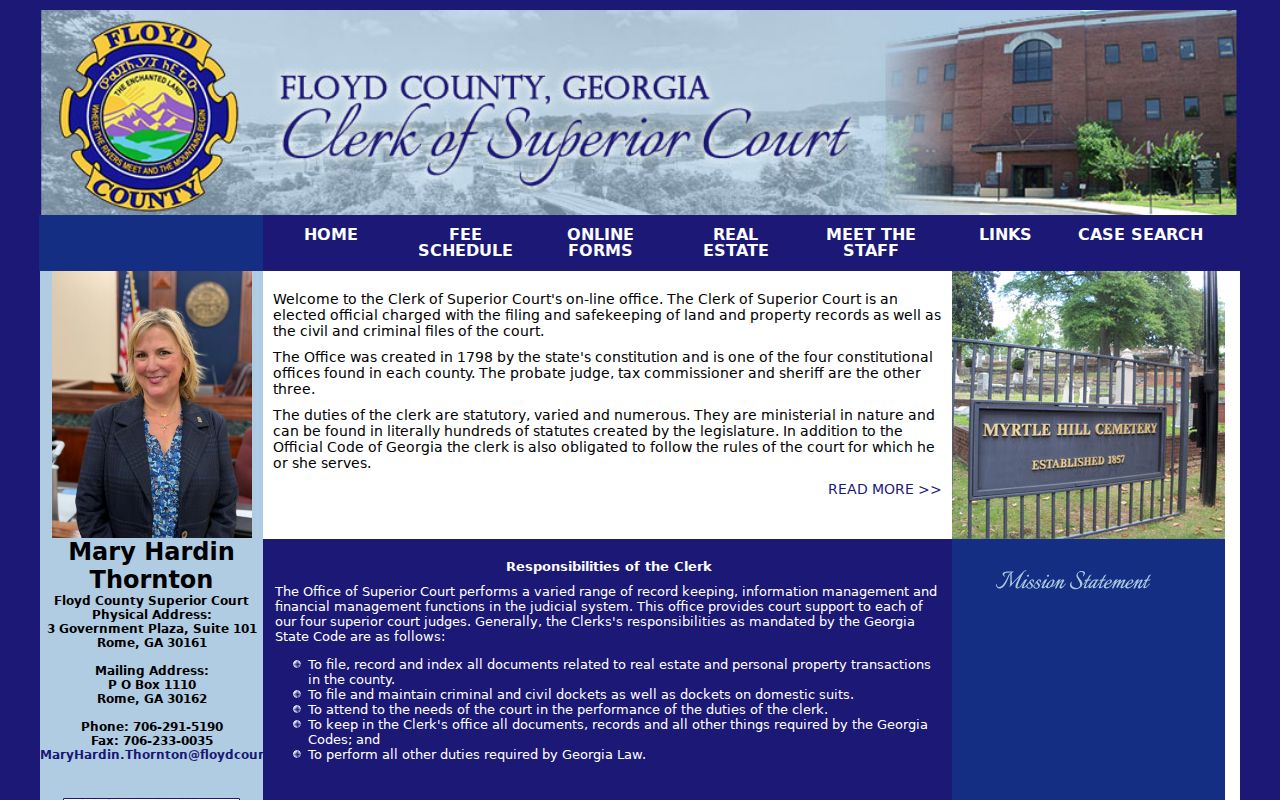
That physical access route keeps an address history moving when a subscription or online index cannot supply the image.
For departmental records such as permits, request a specific existing file by address, PIN, record type, and date span. Georgia Open Records Act requests generally receive a response within three business days, with reasonable search, redaction, and copy fees possible.
Rome's Deed Book F Bridge
Floyd County was created from Cherokee lands in 1832. County deeds and court records begin after that point; earlier land history belongs in Cherokee and Georgia land-lottery material rather than a Floyd recorder search. The Georgia Archives Virtual Vault provides an indexed scan of Floyd Superior Court Deed Book F, 1848 to 1850. Its catalog notes faded ink on some pages.
The Archives viewer below is direct proof that at least this early volume survives online.
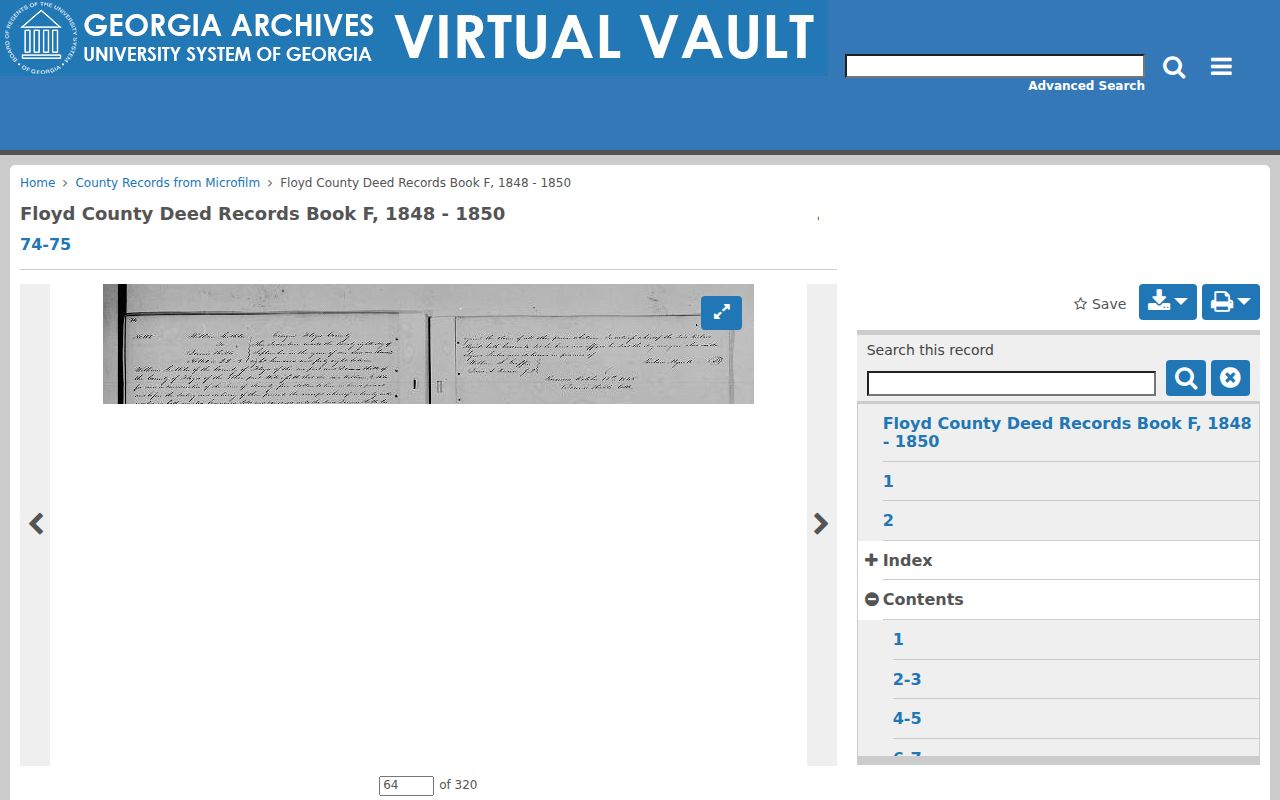
Match its people and descriptions to later deeds before treating it as part of the same parcel chain.
This is an unusually useful local bridge, but it is not evidence of a complete online run. The modern Clerk, courthouse books, county microfilm, and Archives each hold a different part of the trail. No official source reviewed supports a courthouse-fire loss claim for Floyd, so one should not be added to a Rome house history.
Rome Directories Fill Ownership Gaps
Deeds name owners, not necessarily everyone who lived at the address. Documented Rome city-directory editions include 1913, 1916, 1919, 1926, 1931, 1934, 1936, 1938, 1947, 1950, 1952, 1953, 1955, 1957, 1958, 1959, and 1960. Telephone-directory runs cover about 1936 to April 1947 and April 1948 to March 1961; Rome-Floyd County Library's Heritage Room catalog lists telephone books for 2010 to 2013.
A normal alphabetical entry may give surname, given name or initials, spouse, job, and home address. A reverse or criss-cross section, when present, lists the street and house number first. It is the better tool for asking who lived here before. Yet editions omit people, and a disappearance may reflect a move, death, marriage, annexation, or publisher choice.
Polk's Rome directory geography also reached named communities such as Garden Lakes, Horseleg Estates, Lindale, Mount Berry, Riverside Village, Shannon, and Sherwood Forest. A Rome heading therefore does not by itself prove residence inside city limits. The separate Rome city directory page covers the collections and entry conventions.
Hold a Rome Address in 1915
Rome's February 1915 Sanborn fire-insurance atlas contains 36 sheets. It can show building footprint, construction material, use, street name and number, and block form. That makes it valuable when a directory name must be tied to a physical structure rather than only a printed address.
Start with the street index and locate the sheet. Compare the target building with lot lines, nearby intersections, adjoining structures, and any old number. Then test the result against a 1913 or 1916 directory and deed descriptions. A Sanborn label dates the mapped structure, not every person who occupied it.
The map also helps bridge suspected renumbering. No authoritative citywide Rome renumbering year was found. Use physical location, plat, legal description, and adjoining owners instead of inventing a date.
Note: A map stabilizes the building and block, while a dated directory or census supplies the household name.
Pair Rome Directories With Census
Public federal census schedules now run through 1950 under the 72-year release rule. Rome's 1950 search geography uses wards, Militia District 919, rivers, Third Avenue, and ward lines. Those descriptions can locate a family when the street is poorly indexed.
Use a short paired-source process:
- Copy a directory entry exactly, including spouse, work, abbreviations, and address.
- Check the nearest prior and later available editions for continuity or change.
- Locate the address in the nearest census year, using enumeration descriptions and maps when name search fails.
- Compare household members, relationships, ages, and birthplace with the directory identity.
- Return to deeds or newspapers for the years between census releases.
The census can reveal a household and relationships that a directory omits. A directory supplies intervening addresses and occupations that the census cannot. Neither source should be forced to fill years it did not record.
Rome Permits Date Building Change
Building permits and code records can explain why an address, footprint, or use changed. They may name an owner, applicant, or contractor and date a project or certificate. Rome does not publish a verified stable permit-result database or a stated historical cutoff. Ask Building Inspection for the precise address and parcel instead.
Compare a permit date with deed transfers, QPublic building characteristics, GIS imagery, and the Sanborn footprint. The person who applied for work is not automatically a resident. Still, the file can explain an addition, demolition, conversion, or new structure that interrupts an address trail.
Close Rome Resident Trails Carefully
Obituaries, probate cases, cemetery records, and deed transfers from an estate can close the trail of a former owner or occupant. Floyd's Georgia Probate Records portal covers 2006 forward, while the Probate Court at 3 Government Plaza holds wills, estates, guardianships, and related files. Public petitions, representatives, notices, and estate conveyances may connect decedents and heirs; protected attachments remain unavailable.
Georgia Historic Newspapers exposes older Floyd titles. Search surname variants, the address, spouse, employer, funeral home, and cemetery because OCR can miss the expected name. Rome News-Tribune legal notices also connect people and property through foreclosure notices. Myrtle Hill and Rome's other municipal cemetery and mausoleum records add an uncommon local source for family history.
Never treat a probate party as proof of residence without another address source. An executor, lawyer, heir, or creditor may appear in the case while living elsewhere.
Lawful Rome House History
Previous residents research is strongest when it serves family history, architectural history, estate work, or informed personal curiosity. An owner's name is not a roster of occupants. An old directory is not proof of a current address. Protected voter locations, restricted vital certificates, driver data, and sealed records remain outside an ordinary address search.
Keep a research log with the source, date, spelling, address form, citation, and confidence level. Mark an owner as owner, a subscriber as subscriber, and a census member as a household member for that census date. Those labels preserve the difference between what a record says and what a researcher infers.
Lawful use. Trace Rome previous residents for legitimate personal and historical purposes. Never use address evidence to stalk, threaten, harass, or locate a protected person.