
Rome City Directory Editions
Rome city directory evidence begins with documented editions in 1913 and continues through a noncontinuous run ending in 1960. Known years include 1913, 1916, 1919, 1926, 1931, 1934, 1936, 1938, 1947, 1950, 1952, 1953, 1955, and 1957 through 1960. That list is not proof that each missing year was never printed. It reflects volumes found in established genealogy catalogs and institutional digitizations. Ask the Rome-Floyd County Library Heritage Room to confirm a volume before planning a visit.
| Collection | Years | Where Held | Access |
|---|---|---|---|
| Rome city directories | Documented editions, 1913-1960 | FamilySearch and institutional catalogs | Catalog; some images require affiliate or library access |
| Polk's Rome directory | Exact run not confirmed | FamilySearch Library catalog | Catalog or affiliate access |
| Rome white and yellow pages | Circa 1936-April 1947; April 1948-March 1961 | Library of Congress and Digital Library of Georgia | Digitized or microfilm metadata |
| Rome telephone directories | 2010-2013 | Rome-Floyd Heritage Room | Library shelf |
The accessible local catalog does not give a shelf-by-shelf inventory or identify every publisher beyond Polk. Treat the years as documented points, not a continuous run. Allen County Public Library describes a digitized Rome grouping for 1913-1934, while later phone-book runs appear through national library records. Catalog access and image access are not the same. Some entries can be viewed only through a partner library or FamilySearch affiliate.
A good collection log should separate what has been confirmed from what still needs a shelf check. List the title as the catalog gives it, the stated year, the institution, and whether the item is a catalog record, scan, microfilm, or print volume. This avoids a common mistake: treating a broad date range in collection metadata as proof that every annual issue exists. Rome's known editions have long breaks. Those breaks should guide the search toward telephone books, newspapers, census records, and local manuscript collections instead of prompting a claim that a directory was published each year.
Rome Heritage Room Shelves
The Rome-Floyd County Library Heritage Room, at 205 Riverside Parkway NE, is the best local fallback when a digital catalog stops at a title record. Call 706-236-4601 to ask whether a specific directory year is on a shelf, microfilm, or a subscription database. Staff can also point to related Floyd County volumes. The regional Georgia Room catalog lists early marriage abstracts, 1930-1940 vital-statistics books, cemetery transcriptions, church histories, and recent telephone directories.
Bring a full name, a rough year, and any known street. When requesting staff help by phone, state whether the goal is a name entry or an address in a reverse section. The public catalog does not prove that every Rome city directory volume remains available. A direct shelf check prevents a wasted trip and may reveal a related source that is not described online.
The catalog's companion material is especially useful when a surname is common. The early Floyd marriage abstracts can distinguish couples, cemetery transcriptions can supply death and family clues, and the 1930-1940 vital-statistics books sit close to several documented directory years. St. Peter's Church's 150-year history and other congregational materials may place a family in a community that a commercial directory treated only briefly. Ask for copying rules before photographing pages, and always capture the title page so the volume and date remain tied to the entry.
Rome Telephone Directory Runs
The Digital Library of Georgia collection record and the Library of Congress catalog document Rome white and yellow pages from about 1936 through April 1947, followed by another run from April 1948 through March 1961. These books differ from full city directories. A telephone listing normally gives a subscriber's name, street address, and number, but may omit other adults in the home and anyone with an unlisted telephone.
Search both the resident and business portions. A shop listing may tie a family surname to a firm or street when the home line is absent. Record the publication month because a yearly label can hide the fact that the book reflects only one point in that year. Short gaps should be checked in newspapers and the nearest census schedule.
Telephone books also reflect who paid for or controlled the listed line. They are not complete household rolls. A spouse, adult child, boarder, or person without service may live at the address yet never appear by name. The yellow pages can still be valuable when the alphabetic listing gives only a firm name. Match the business address and telephone number across both sections, then test the owner or officer through a newspaper advertisement or city record. Keep the limits clear: the listing shows a published connection at that date, not every resident of the home.
Reading Rome Directory Entries
A typical alphabetic Rome city directory entry can include a surname, given name or initial, spouse in parentheses, occupation or employer, and home address. Read the volume's own key before expanding a short form. Conventions can shift by publisher and year, and a single letter can change the meaning of a line.
| Name | Surname, given name or initial; a spouse may appear in parentheses |
|---|---|
| Work | Occupation, employer, or business name when supplied |
| Address | House number and street; h can mean home, r residence or rooms, and bds boards |
| Telephone | Common in later phone books, but absent for unlisted or nonsubscribing residents |
| Family clue | wid marks a widow and may include the deceased spouse's name |
- Criss-cross directory
- A later address-first section arranged by street and house number rather than surname.
- Householder index
- A list centered on the named head or principal subscriber in a home.
- Abbreviation key
- The publisher's legend for short forms. Save it with any copied entry.
Transcribe punctuation and initials rather than silently expanding them. If an entry reads “Jno,” record that form before also searching John. If a spouse appears in parentheses, search both names in the next edition. A widow notation can provide the deceased spouse's given name, but it does not state a death date. Check an obituary, cemetery file, or official vital source before adding that date to a family history. The abbreviation page is part of the evidence because it proves how that publisher used each mark.
Polk's Wider Rome Directory
Polk's Rome directory did not describe only a narrow downtown core. Its catalog statement names Beech Creek subdivision, Field Wood, Garden Lakes, Horseleg Estates, Lakemore Heights, Lindale, Mount Berry, Riverside Village, Shannon, and Sherwood Forest. That broad reach makes the collection valuable, but it also creates a trap: appearing in a Rome directory does not prove that an address was inside the incorporated city.
Check the place label exactly as printed. Then compare the address with the Rome-Floyd GIS or a period map. Postal names, county boundaries, and city limits answer different questions. This geography matters most for Lindale, Shannon, Mount Berry, and the suburban communities that appear under the Rome publishing market.
A person listed under Mount Berry may have a college tie, while an entry under Lindale or Shannon may belong to a county community included for the convenience of directory users. Preserve the community heading and page number with the name. When two same-name residents appear, geography can separate them more safely than an assumed family link. Later maps can help orient the address, but they should not overwrite the place wording used in the historical volume.
Pair Rome Directories With Census
Federal census schedules add age, birthplace, relationship, and a full household to the short directory line. The free 1950 Floyd County census search supports names and enumeration districts. Rome's 1950 geography was divided by wards, militia districts, rivers, and avenues, so an address can help when a surname search gives several matches.
The image below shows the official NARA search used to bridge the 1950 Rome city directory era. It is a census interface, not a modern resident list.
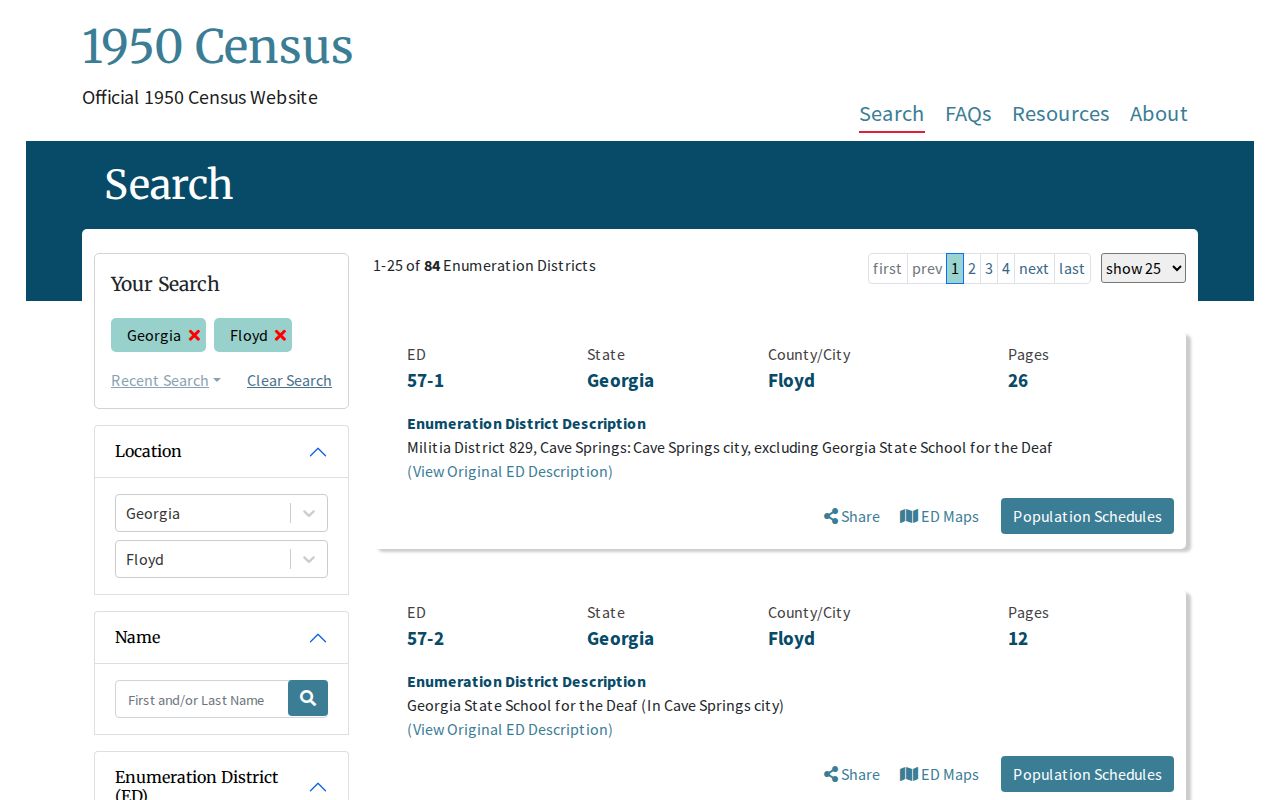
A census household can confirm which person at a Rome address matches a directory initial, while the nearby directory years show moves between federal census dates.
Work outward from a solid match. First compare surname, given name, spouse, and street. Then check occupation, age, birthplace, and household members. The census enumeration date and the directory publication date may be months apart, so a move between them is possible. If the family cannot be found by name in 1950, use the address and NARA enumeration-district tools. Rome's river and ward descriptions can narrow the correct district before page-by-page browsing begins.
Rome Directory Gaps in Newspapers
Georgia Historic Newspapers lists Floyd County titles with issue ranges and searchable scans. Use it when a resident disappears between available city directories. Search the full name, surname with spouse, exact address, employer, funeral home, and cemetery. Optical character recognition can misread old type, so repeat the search with initials, shortened names, and spelling variants.
Obituaries may identify relatives, a former address, church, funeral home, and burial place. Legal notices can date a property event. These clues explain a directory gap, but they do not by themselves prove that two people with the same name are one person. Pair the notice with an address, spouse, deed, or census household.
Search the address without the resident's name as well. Advertisements, lost-and-found notices, social items, and legal publications can reveal a connection missed by poor name recognition. Hyphenated and compound surnames deserve several forms, and older indexes may drop accents or reverse parts of a name. Rome's current language diversity reinforces a basic archive habit: search what the source may have printed, including initials and altered name order, without inferring identity from ethnicity.
Note: Save the newspaper title, issue date, page, and exact spelling so another researcher can retrace the Rome record.
Rome's 1915 Block Record
The public-domain 1915 Rome Sanborn atlas contains 36 sheets. It does not name every occupant, but it can hold a location steady when street wording or house numbers shift. The sheets show building footprints, uses, materials, and the form of a block. Compare a directory address with the correct atlas sheet before assuming that a later building is the same structure.
This is one of Rome's strongest historical pairings. The city directory supplies a person and address, while the atlas supplies the physical setting. A deed then provides the legal ownership trail. Together they can distinguish a move by the household from a renumbering or rebuild at the site.
Begin by finding the block, not by forcing a modern house number onto the sheet. Note cross streets, lot shape, building outline, and labeled use. Then compare the closest directory year and the legal description in a deed. A Sanborn sheet can show that a structure existed, changed form, or carried a business use, but it cannot prove who owned or occupied it on its own. That proof must come from the named and legal records.
Trace Family Through Rome Directories
Build a timeline, not a pile of isolated results. Start with the year closest to a known life event. Copy each Rome city directory line as printed, including the spouse, work, address, and abbreviations. Then move one available volume at a time. A missing name can mean a move, death, marriage and name change, an unlisted telephone, annexation, or a publisher omission.
- Find the first likely name entry and save the full citation.
- Check the prior and next documented edition, noting each move or work change.
- Use a criss-cross section, if present, to test the address and nearby household names.
- Pair the nearest 1910, 1920, 1930, 1940, or 1950 census household with the directory result.
- Close the trail with a newspaper, probate, church, or cemetery record.
The Heritage Room's church and cemetery resources add depth. Its catalog identifies St. Peter's Episcopal material, First Baptist resources, Floyd cemetery volumes, marriage abstracts from 1834-1884, and vital-statistics volumes for 1930-1940. Berry College archives and the Martha Berry Digital Archive can help with Mount Berry school and community ties. Use those sources to test a lead, then verify legal ownership or a vital event with the proper custodian.
Keep a source-by-source timeline for each person. A directory supplies a published address and work link. A census supplies a household on its enumeration date. A newspaper adds a dated event, while cemetery and probate sources can close the life trail. Do not merge those roles or let one record claim more than it states. When the name disappears, search a spouse, adult child, employer, and the former address before deciding the family left Rome. If the modern question shifts to a current name rather than the historical shelf, use the resident lookup process instead of extending an old directory entry beyond its date.
A complete citation makes later review much easier. Record the directory title, publication year or month, publisher when shown, section, page, entry text, repository, and image or catalog URL. For a staff lookup, also note who supplied the result and the date of contact. That record preserves the distinction between a page personally inspected and a reference reported from a shelf. It also makes spelling variants visible across Rome city directories instead of smoothing them into one unsupported form.