
Choose the Right Rome Resident Record First
Start with what you already know. A current street address points to Floyd County's parcel roll and map. A name opens the owner index, deed parties, court dockets, probate matters, voter tools, and business filings. An old address is different territory. It belongs in city directories, telephone books, census schedules, deeds, newspapers, and fire-insurance maps. Each source records one relationship at one moment. None is a full census of Rome.
Owner records leave out renters and other household members. Voter rolls skip the unregistered and shield qualifying VoteSafe participants. Telephone books omit unlisted subscribers. Court and business filings mark a legal event or role, not necessarily a home. Treat every hit as a dated lead, and require at least two matching anchors, such as a middle initial and parcel, a spouse and address, or a business role with a consistent date sequence.
- Search Floyd QPublic by owner or location and distinguish the parcel's situs from the tax-mailing address.
- Use Georgia My Voter Page for a personal registration check, or lawfully order the appropriate voter list when broader research is justified.
- Follow owners through the Floyd Cott eSearch guest index, GSCCCA, and the courthouse Deed Room.
- For an earlier household, consult Rome city and telephone directories, census schedules, and Floyd historical newspapers.
- When an existing public record is not online, send a narrow Georgia Open Records Act request to the office that keeps it.
Where Rome's Resident Rolls Are Kept
Rome is the Floyd County seat. Most resident evidence is county-held. The Clerk of Superior Court records deeds, liens, plats, divorces, and Superior Court files. The Board of Assessors keeps parcels and owner mailing addresses. Elections staff handle registration. The Secretary of State supplies My Voter Page and ordered list products. City offices add municipal court, police, permits, cemetery, archive, and GIS material. The Rome street directory maps the address-first route through these systems.
Floyd County Clerk of Superior Court
3 Government Plaza, Suite 101
Rome, GA 30161
706-291-5150
Floyd County Board of Assessors
4 Government Plaza, Suite 203
Rome, GA 30161
706-291-5143
Floyd QPublic Separates Owner, Mail, and Site
The Floyd County QPublic application accepts owner, location, parcel, map, and advanced searches. A parcel card can be rich. It may show the current owner, owner mailing address, physical location, parcel identification, legal description, acreage, land and improvement values, sales, photos, and map links. Search companies as well as individuals. Try surname variants too. A parcel held by an estate, trust, or limited-liability company may require a deed or business filing before you reach a person.
| QPublic field | Best Rome use | Important distinction |
|---|---|---|
| Owner Name | Find an individual, estate, trust, or company | Partial spelling may help |
| Location Address | Find the parcel at a street address | This is the situs, not tax mail |
| Parcel Number | Return to one exact Floyd PIN | The identifier can outlast address wording |
| Map | Inspect nearby parcel context | Confirm ownership on the parcel card |
| Advanced Search | Narrow by available property fields | Live options can change |
Ownership is not occupancy. Rome's recent Census estimates put owner occupancy at 49.2%. Even an individual owner may list a mailing address that is a different property, a post-office box, or an agent. The roll establishes assessed ownership, not every resident of the dwelling.
Rome Deeds Continue Beyond the Web Index
The Floyd Cott eSearch portal offers a free guest index. Document images require temporary access or a subscription. GSCCCA provides another statewide route for real estate, liens, plats, UCC records, and related searches. Search both grantor and grantee spellings. Note book, page, instrument type, filing date, and legal description before opening an image.
Online holdings are expressly limited. If an indexed image or older book is missing, visit the Deed Room at 3 Government Plaza or request a copy by mail from the Clerk. Older microfilm continues through Georgia Archives. Self-filed real-estate documents have used mandatory electronic filing and GSCCCA identity verification since January 1, 2025. The counter survives. So do the older physical books.
The official Floyd deed index page displays its separate guest, image, and monitoring paths.
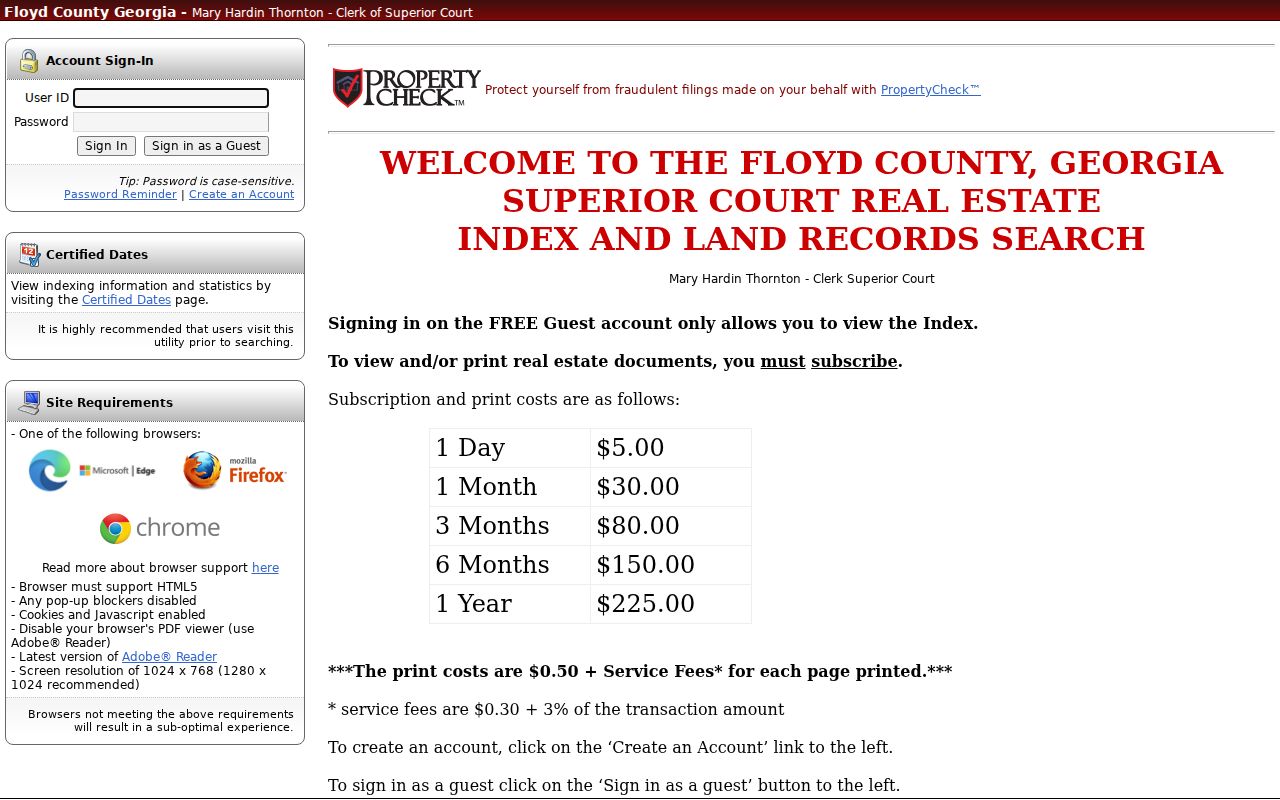
That separation matters. A free citation may be enough to order the correct instrument even when the full image sits behind payment or a courthouse visit.
Georgia's Voter Sources Answer Different Questions
Georgia offers two very different voter tools, and knowing which answers your question saves time. My Voter Page works as a personal lookup gated by identity. You supply a first initial, last name, Floyd County, and a date of birth. A match brings back registration status and the registered address. It also shows precinct and districts, polling place, a sample ballot, and absentee status. It cannot browse a whole street. For that kind of address research, order the municipal or county voter file from the Secretary of State. It comes prepaid and is delivered electronically.
The published voter file carries more than 40 fields. These cover status, address, precinct, municipality, and district. Phone numbers, full birth dates, Social Security numbers, and driver-license numbers stay out. Georgia registers no one by party. So the "Last Party Voted" field only records primary participation, never membership or a ballot choice. Commercial use is a misdemeanor under O.C.G.A. §21-2-601, and VoteSafe protection shields qualifying residential addresses.
The official Georgia My Voter Page displays the identity fields used for a personal Rome voter check.
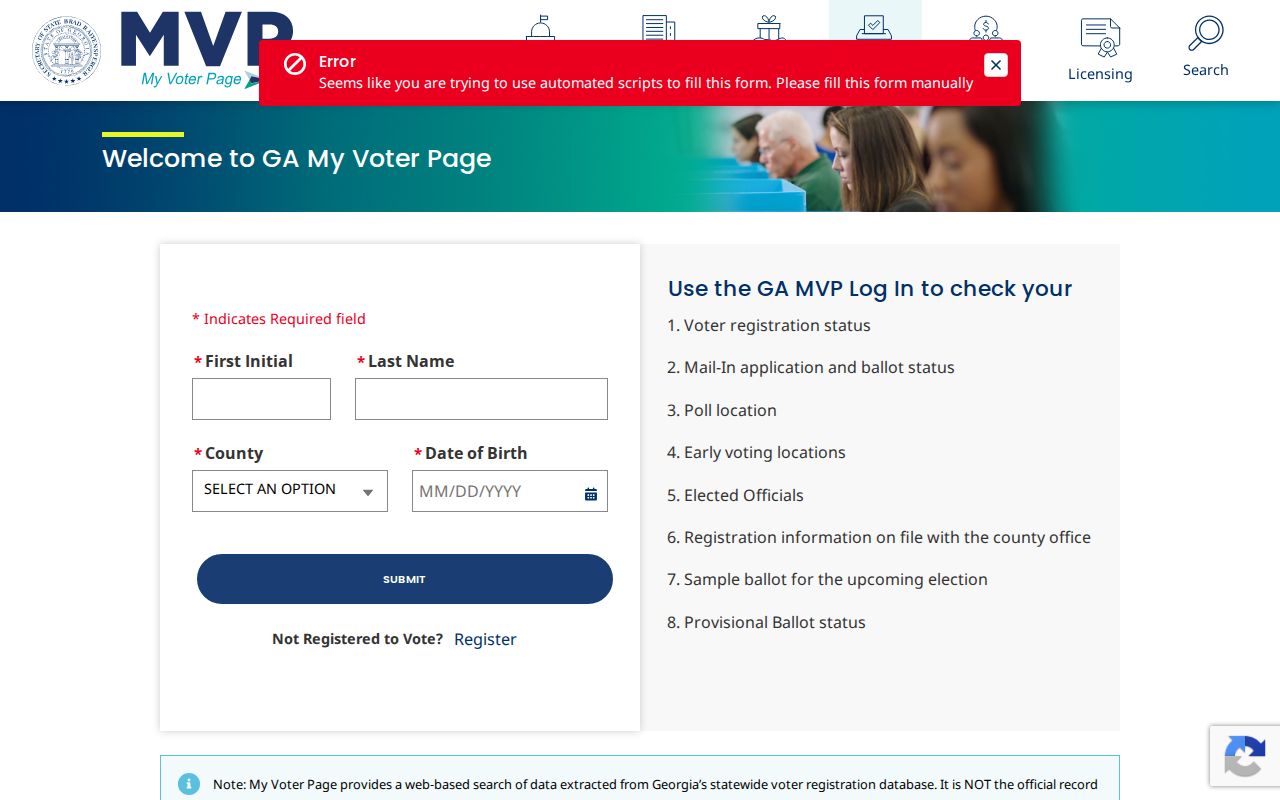
Since that screen demands personal identifiers, do not confuse it with a public street-browsing directory for Rome.
Current Rome Directories and Official Indexes
Current sources cover defined groups. Not every Rome household appears. Pick the roll that documents the needed relationship, preserve its date, and verify the result elsewhere, since a Rome resident lookup combines these sources without treating any single hit as proof of current residence.
| Rome-area source | People represented | Custodian | How to reach it |
|---|---|---|---|
| Floyd QPublic | Parcel owners and mailing addressees | Board of Assessors | Free web search; office help |
| Georgia voter sources | Registered voters | Secretary of State / county registrar | Personal MVP or paid lawful list |
| Floyd deed index | Grantors, grantees, lien parties | Superior Court Clerk | Guest index, paid images, counter |
| Rome staff directory | City departments and public contacts | City of Rome | Free online directory |
| Business and license indexes | Agents, officers, named licensees | Georgia SOS and boards | Free official searches |
Rome and Floyd County publish no official HOA membership roster. Homeowner associations keep their lists private. Civic clubs, churches, schools, and fraternal groups do the same unless they choose to publish or donate rosters to an archive. The Rome-Floyd Library Heritage Room holds accessioned newsletters and historical membership lists that groups have placed on deposit, so it is the natural stop for association records with archival standing.
One public-safety roster works differently. The Georgia Bureau of Investigation registry is the authoritative source for that narrow category, not a general resident lookup for Rome.
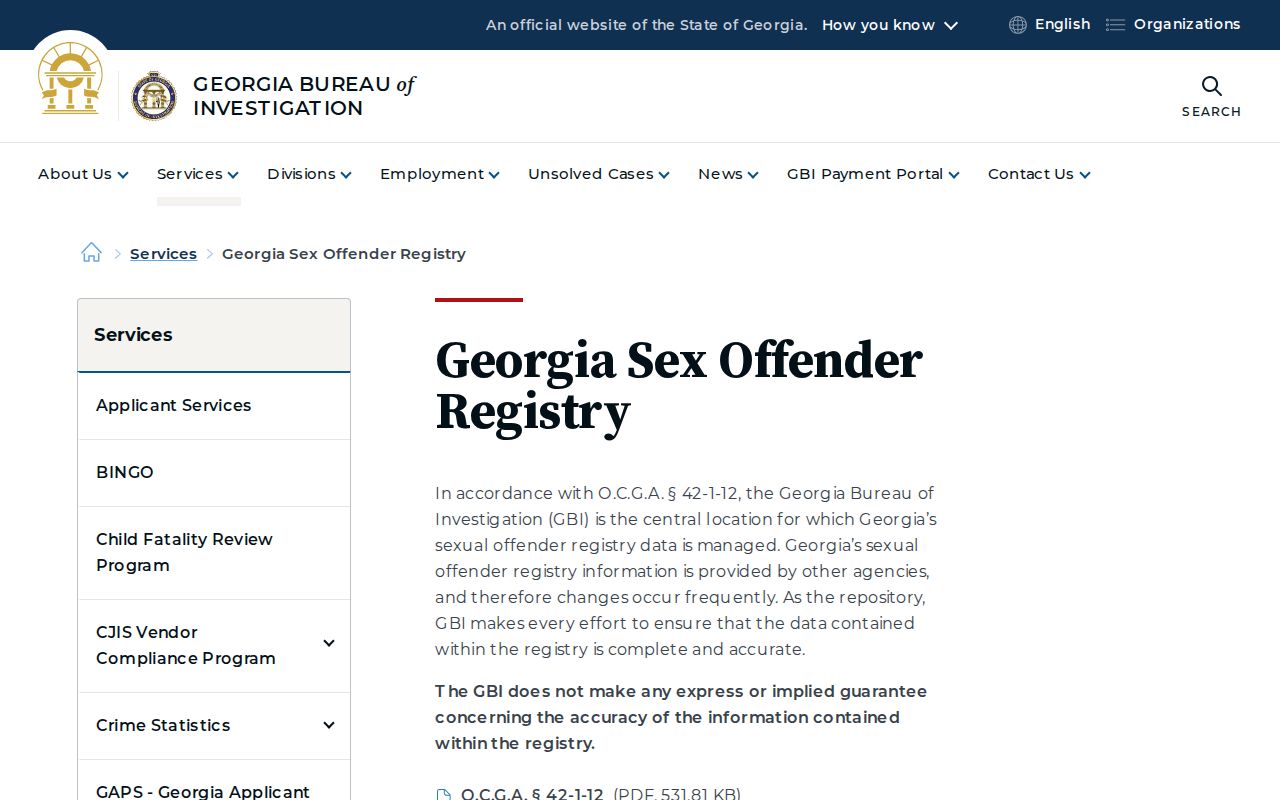
Inclusion in that registry follows statute. It covers only listed offenders, never everyone at an address, and the information must never be used for harassment.
Rome Court Names Must Go to the Correct Clerk
Rome court records sit in separate clerk files. Superior, State, Magistrate, Probate, and Juvenile courts in Floyd County each keep their own dockets. So does Rome Municipal Court. The Georgia court e-access directory lists the vendors that sell electronic access, but Floyd County does not appear on its provider table. That makes the local clerk the dependable route.
Search with care. Use a normalized full name plus middle initials and spelling variants. Note the party role too. Then verify case number, filing date, and disposition against the file itself. Sealed matters, juvenile records, and protected attachments stay off limits.
Probate offers a genuinely useful statewide index. It covers estates, wills, guardianships, marriages, and petitions from 2006 onward, subject to county and record limits. An heir search can run from a public probate petition to the personal representative and on to an estate deed. Remember that a name match alone never proves two same-name people are the same resident.
The Georgia Courts e-access page shows why any Rome search must first pin down the participating court and its provider.
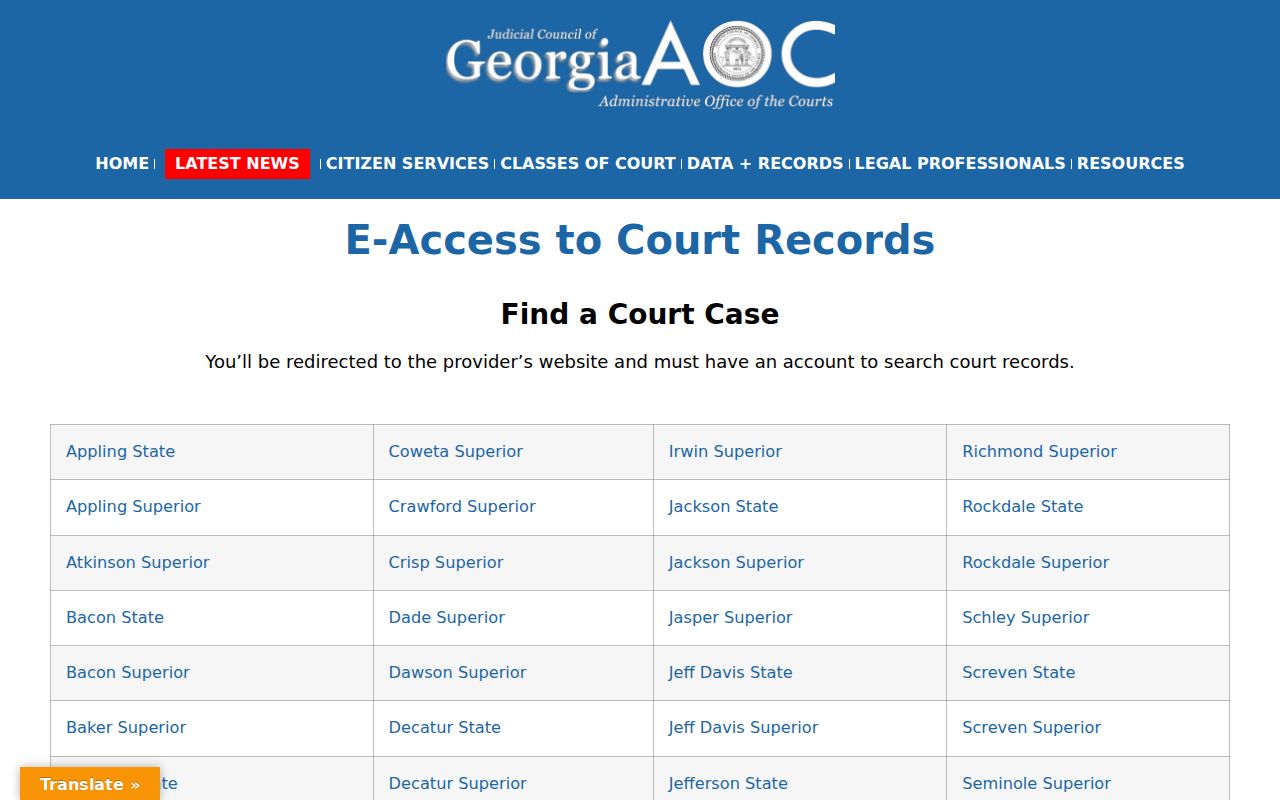
Treat the provider directory as an orientation tool. For the local file, the Floyd or Rome clerk remains the authority. For estates and wills, the Georgia Probate Records search offers the separate statewide entry point Floyd Probate Court uses.

Its Floyd coverage runs from 2006 to the present, which makes it a strong starting index. Older or protected material still belongs with the county clerk.
Marriage, Divorce, Birth, and Death Split by Era
Vital records in Georgia divide sharply by era and event. Georgia DPH holds births and deaths from January 1919 forward. It holds marriage certificates from 1952 through 1996. Divorce verifications cover June 1952 through August 1996. Floyd Probate Court supplies local marriage licenses issued before 1952 and after 1996. The Floyd Superior Court Clerk keeps the actual divorce decrees granted there. Remember that a DPH divorce verification is not the signed decree itself.
Certified births and deaths are not open to general public inspection under O.C.G.A. §31-10-25. Applicants must qualify and show identification. Ordering channels include DPH mail, online ordering, and a county vital-record office. Walk-in service is also available. Stated timing runs from same-day walk-in service to two to four weeks online and eight to ten weeks by mail. Restricted certificates are off limits. Lawful genealogy work can lean on historical indexes, cemetery sources, newspapers, and probate records.
The Georgia DPH request page distinguishes record types and ordering routes.
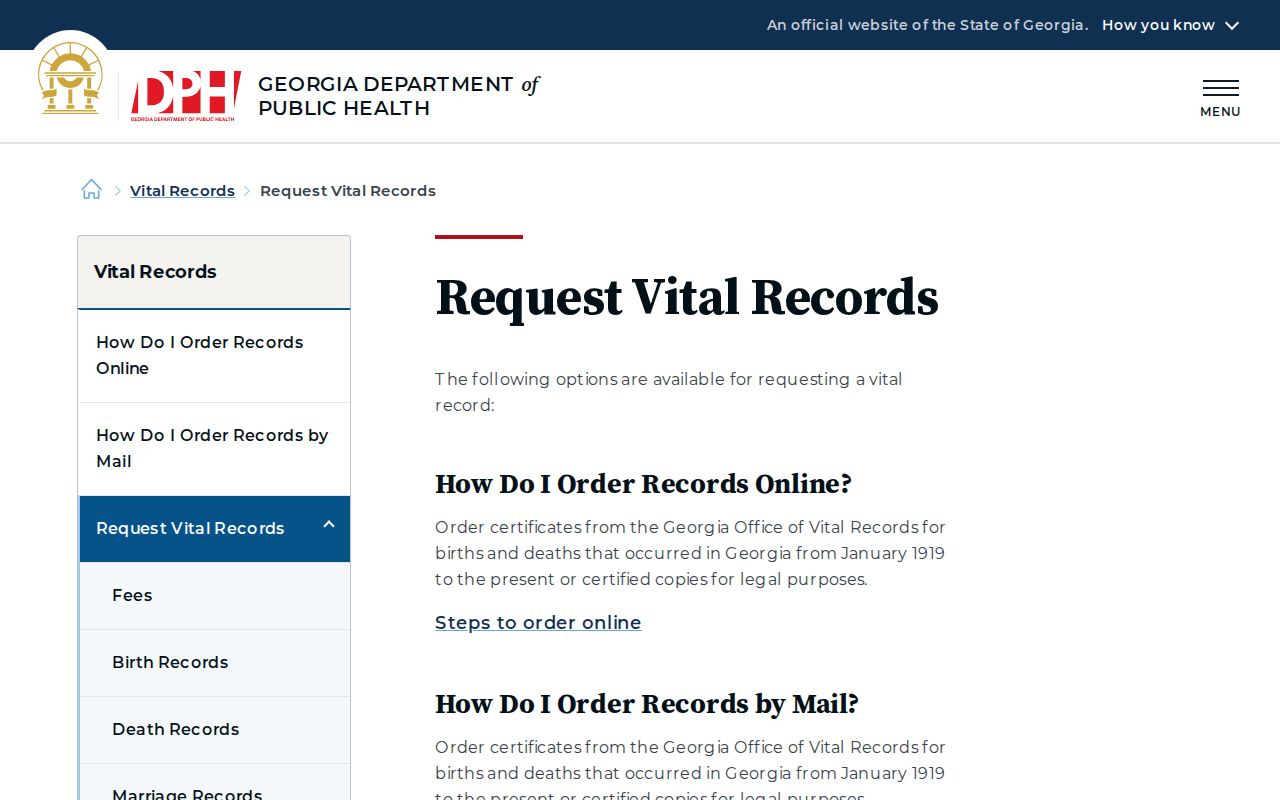
Pick the custodian by event year before paying anything. The state office, Probate Court, and Superior Court do not issue interchangeable documents.
Rome Business and License Names Add Affiliation
Business records add affiliation to a Rome name. The Georgia Corporations Division business search accepts a business name or a control number. It also accepts a registered agent or officer. It can surface entity roles and business addresses. The Secretary of State's professional verification search supports name and license fields, including wildcard techniques. Medical, nursing, real-estate, legal, and other board indexes add status and professional contact details where published. Rome's City Clerk keeps business- and alcohol-license records. No comprehensive public city license database exists online, so request an existing register directly.
These sources matter locally. Rome anchors health care, education, manufacturing, retail, and services for the region. They prove a recorded business or credential relationship, not a private residence. Pair an entity address with a parcel, a filing history, or other dated source. That step comes before concluding anything about a person.
When a Rome Portal Ends, Request the Existing Record
Georgia's Open Records Act, O.C.G.A. §50-18-70 et seq., gives residents a fallback whenever Rome records never made it to a portal. Address the request to the office that actually holds the record. Name the record type, the date span, and any address or case number. Then ask for electronic delivery and a cost estimate. Agencies generally must respond within three business days. Inspection, copying, search, retrieval, and necessary redaction can carry reasonable charges under §50-18-71.
Ask for something that already exists. An index, a file, or an export is fair game. Demanding that staff build a new report is not. Rome's own archive can keyword-search minutes and departmental PDFs, and the city Form Center routes several local requests. For older material, the strongest fallback chain is the courthouse counter, the Rome-Floyd Library Heritage Room, and Georgia Archives microfilm. That chain covers deeds, court books, directories, and election records alike.
The official Georgia open-records request example shows the identifying fields a request should include. It also shows how fees get explained.
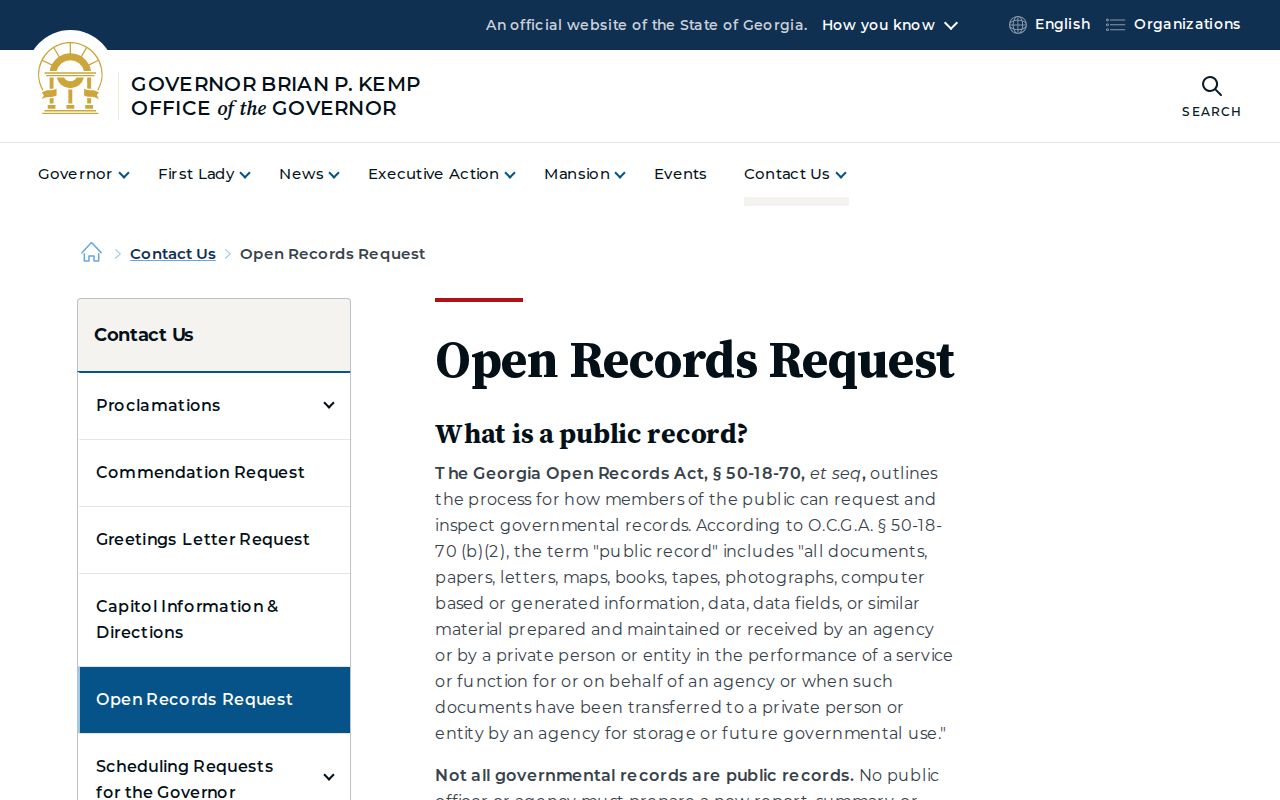
A precise request helps the custodian locate the existing Rome or Floyd County record. It also preserves the exemptions that protect sensitive information.
Historical Rome Residents Across Shelves and Scans
Rome's published city directories survive in pieces, not as one unbroken set. Editions appear between 1913 and 1960, with gaps. Digitized white and yellow pages span roughly 1936 to April 1947. The run picks up again from April 1948 to March 1961. The regional Georgia Room catalog adds Rome telephone books from 2010 through 2013. Polk's Rome directory matters for another reason. It reaches named communities and subdivisions well past the incorporated core. An entry there does not prove an address sat inside city limits.
What a single entry holds depends on the era. City directory listings may give surname, initials, spouse, occupation or employer, and home address. Later telephone books usually list subscriber, address, and number. Reverse sections, where they exist, work the other direction. They turn an address into a likely occupant. Pull the editions just before and after your target year. Then set the directory beside the 1950 census, deeds, Floyd historical newspapers, cemetery records, or the 1915 Sanborn atlas. The Rome city directory guide walks through the fragmented digital runs. It also covers the Heritage Room at 205 Riverside Parkway NE.
Rome's Record Geography Crosses Rivers and Limits
A mailing address that reads "Rome, GA" can easily sit outside the incorporated city. Floyd County still taxes and records it. The Etowah and Oostanaula rivers join to form the Coosa. The rivers split Rome's street geography. Numbered avenues paired with NE, NW, SE, and SW directionals make exact address forms matter. Mount Berry carries its own institutional postal geography. Named areas like Lindale, Shannon, Garden Lakes, and Horseleg show up differently in directories, maps, and municipal records. Treat every label with care.
ZIP assignment, incorporated boundary, voting precinct, historic district, and tax parcel are separate layers of the same ground. Annexation can shift which city department keeps a permit or service record. The mailing ZIP stays put. The latest Rome-Floyd GIS settles current jurisdiction; historic maps supply the earlier context. A neighborhood name alone never proves identity, relationship, or residency.
What Rome Records Deliberately Leave Private
Georgia law draws firm lines around what stays private. Vital certificates require statutory eligibility to obtain. Adoption, juvenile, and sealed court files remain restricted. The federal Driver's Privacy Protection Act closes motor-vehicle address data. VoteSafe lets a qualifying voter shield a residence address from disclosure. Utility accounts, school enrollment, private association membership, and the identities of renters or minors simply do not appear in general public directories. A search that comes up empty may mean lawful protection. It may only mean the chosen roll never covered the person.
Use public records for lawful personal research: genealogy, estate work, reconnecting with relatives or classmates, checking a seller's recorded interest, or studying local history. Never try to defeat a protected-address program. Never open someone's account, impersonate a person, or use a directory to watch, threaten, or harass. When a record looks wrong, go to the custodian who created it. That means the Assessors for parcel information. It means the Clerk for deed or court indexing, election officials for registration, DPH for vital amendments, or the responsible licensing board for credential data.
A correction belongs at the source. A copied directory entry or search result cannot amend a government record. Preserve the record date and citation, explain the specific error to the custodian, and ask what evidence its correction process requires.
A Rome Record Timeline From Deed Books to E-Filing
Floyd County was created in 1832, which set the start of county deed, court, and tax custody. Earlier land history runs through Cherokee and Georgia land-lottery material. Georgia Archives has digitized indexed Floyd Deed Book F, covering 1848-1850, complete with warnings about faded ink. Rome's 1915 Sanborn atlas holds 36 sheets. City and telephone directories bridge much of the twentieth century. The 1950 census splits Rome by wards, Militia District 919, river boundaries, and avenues, a useful clue when a street or surname is poorly indexed.
Access milestones keep arriving. Probate's public portal begins in 2006. Recent Rome-Floyd map updates added precinct, transit, and zoning layers, and the Clerk moved self-filers into mandatory electronic real-estate filing in 2025. None of this adds up to one continuous online resident roll, though. A sound Rome residents directory search still hops between web portals, office counters, physical shelves, microfilm, and digitized archives.