
Choose the Right Rome Resident Record First
Begin with what is already known. A current street address points first to Floyd County's parcel roll and map; a name points to the owner index, deed parties, court dockets, probate matters, voter tools, and professional or business filings. An old address belongs in city directories, telephone books, census schedules, deeds, newspapers, and fire-insurance maps. Each source records a particular relationship at a particular time. None is a complete census of everyone living in Rome.
Owner records omit renters and other household members. Voter records omit people who are not registered and shield qualifying VoteSafe participants. Telephone books omit unlisted subscribers. Court and business filings show a legal event or role, not necessarily a home. Treat every hit as a dated lead and require at least two matching anchors, such as a middle initial and parcel, a spouse and address, or a business role and consistent date sequence.
- Search Floyd QPublic by owner or location and distinguish the parcel's situs from the tax-mailing address.
- Use Georgia My Voter Page for a personal registration check, or lawfully order the appropriate voter list when broader research is justified.
- Follow owners through the Floyd Cott eSearch guest index, GSCCCA, and the courthouse Deed Room.
- For an earlier household, consult Rome city and telephone directories, census schedules, and Floyd historical newspapers.
- When an existing public record is not online, send a narrow Georgia Open Records Act request to the office that keeps it.
Where Rome's Resident Rolls Are Kept
Rome is the Floyd County seat, and most resident evidence is county-held. The Clerk of Superior Court records deeds, liens, plats, divorces, and Superior Court files. The Board of Assessors maintains parcels and owner mailing addresses. Elections staff administer registration, while the Secretary of State supplies My Voter Page and ordered list products. City offices add municipal court, police, planning, permits, cemetery, business-license, archive, and GIS material. The Rome street directory explains the address-first route through these systems.
Floyd County Clerk of Superior Court
3 Government Plaza, Suite 101
Rome, GA 30161
706-291-5150
Floyd County Board of Assessors
4 Government Plaza, Suite 203
Rome, GA 30161
706-291-5143
Floyd QPublic Separates Owner, Mail, and Site
The Floyd County QPublic application accepts owner, location, parcel, map, and advanced searches. A parcel card can show the current owner, owner mailing address, physical location, parcel identification, legal description, acreage, land and improvement values, sales, photos, and map links. Search surname variants and companies as well as individuals. A parcel owned by an estate, trust, or limited-liability company may require a deed or business filing to reach a person.
| QPublic field | Best Rome use | Important distinction |
|---|---|---|
| Owner Name | Find an individual, estate, trust, or company | Partial spelling may help |
| Location Address | Find the parcel at a street address | This is the situs, not tax mail |
| Parcel Number | Return to one exact Floyd PIN | The identifier can outlast address wording |
| Map | Inspect nearby parcel context | Confirm ownership on the parcel card |
| Advanced Search | Narrow by available property fields | Live options can change |
Ownership is not occupancy. Rome's recent Census estimates put owner occupancy at 49.2%. Even when the owner is an individual, a mailing address can be a different property, a post-office box, or an agent. The roll establishes assessed ownership, not every resident of the dwelling.
Rome Deeds Continue Beyond the Web Index
The Floyd Cott eSearch portal provides a free guest index, while document images require temporary access or a subscription. GSCCCA offers another statewide route for real estate, liens, plats, UCC records, and related searches. Search both grantor and grantee spellings, then record book, page, instrument type, filing date, and legal description before opening an image.
Online holdings are expressly limited. If an indexed image or older book is absent, visit the Deed Room at 3 Government Plaza or request a copy by mail from the Clerk. Older microfilm continues through Georgia Archives. New self-filed real-estate documents have used mandatory electronic filing and GSCCCA identity verification since January 1, 2025, but that filing change does not eliminate the counter or older physical books.
The manifest capture of the official Floyd deed index shows the portal entry point and its separate guest, image, and monitoring paths.
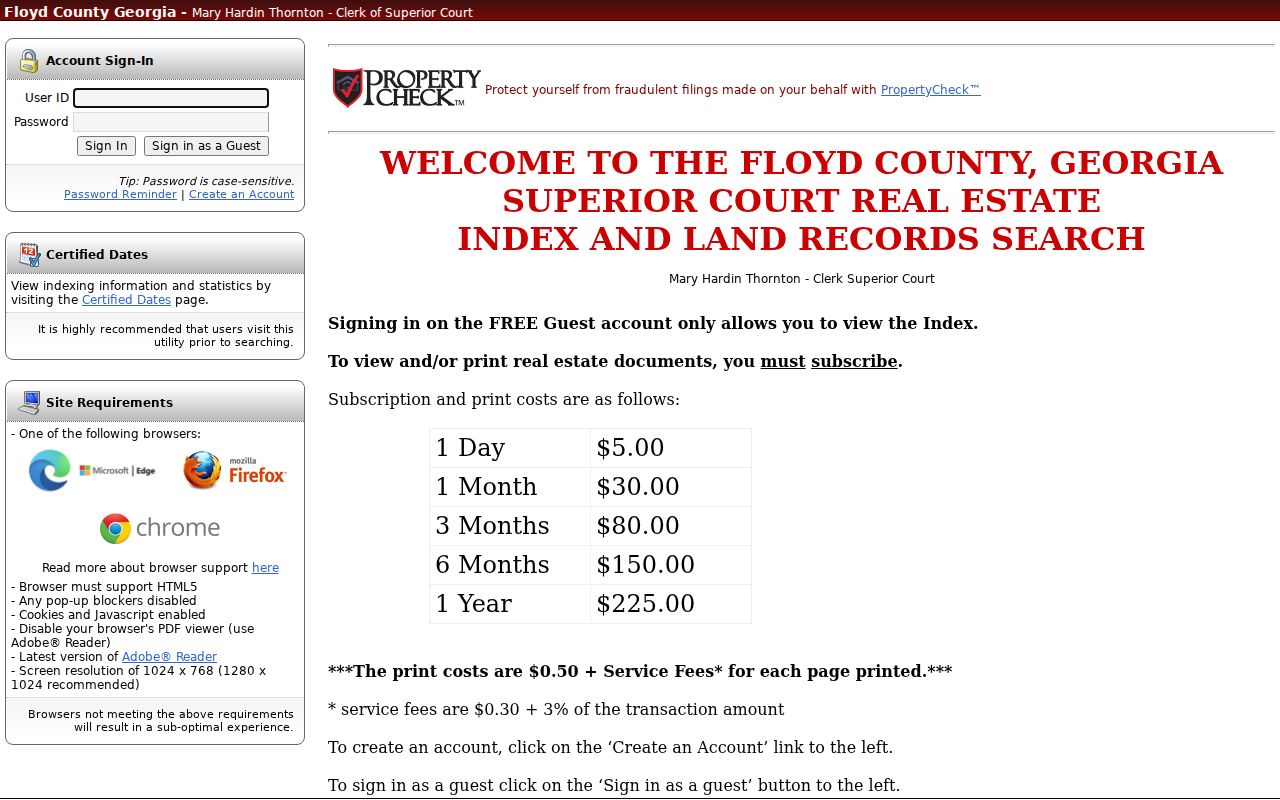
That separation matters: a free citation may be enough to order the correct instrument even when the full image is not available without payment or a courthouse visit.
Georgia's Voter Sources Answer Different Questions
My Voter Page is an identity-gated personal lookup requiring first initial, last name, Floyd County, and date of birth. A match can return registration status, registered address, precinct, districts, polling place, sample ballot, and absentee status. It cannot browse an entire street. Broader address research uses an ordered municipal or county voter file from the Secretary of State, delivered electronically after prepaid ordering.
The published file contains more than 40 status, address, precinct, municipality, and district fields. It excludes phone numbers, full birth dates, Social Security numbers, and driver-license numbers. Georgia does not register voters by party; a “Last Party Voted” field reflects primary participation, not party membership or a ballot choice. Commercial use is a misdemeanor under O.C.G.A. §21-2-601, and VoteSafe shields qualifying residential addresses.
The official Georgia My Voter Page capture shows the identity fields used for a personal Rome voter check.
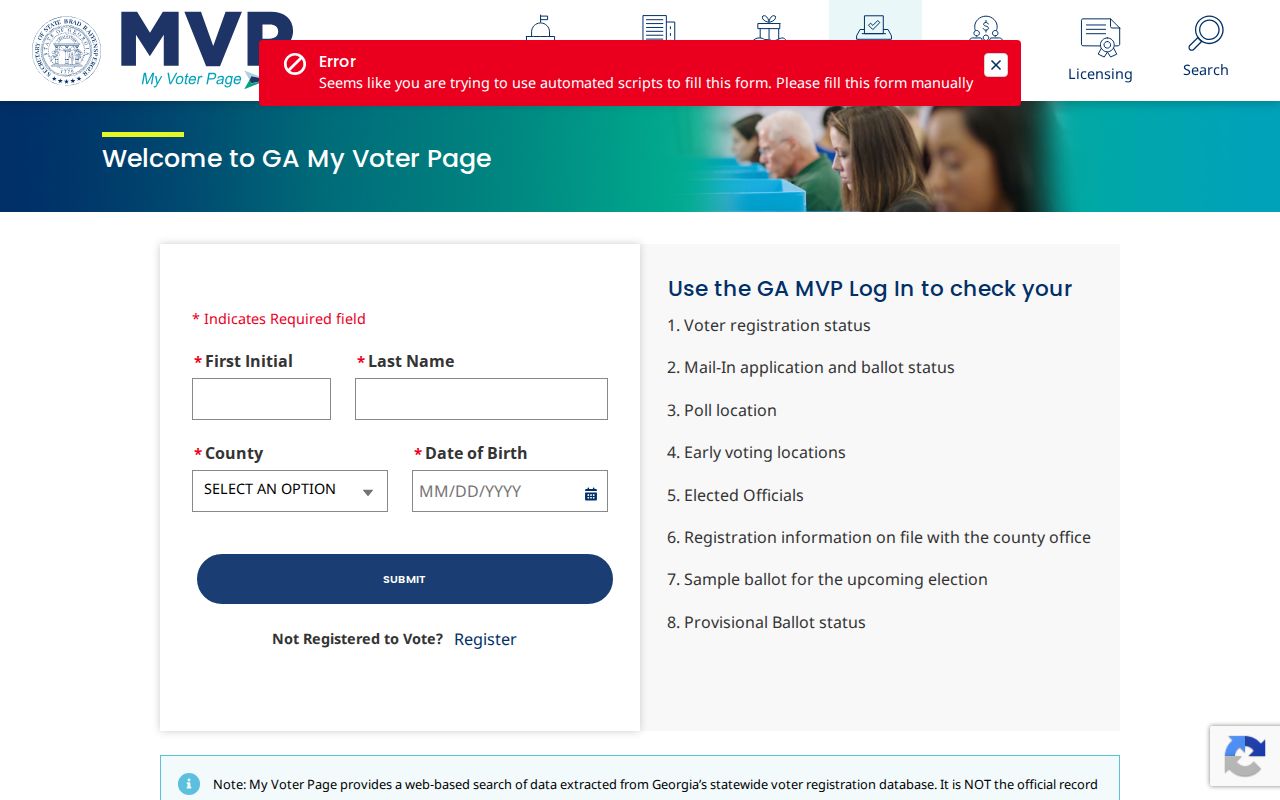
Because that screen requires personal identifiers, it should not be mistaken for a public street-browsing directory.
Current Rome Directories and Official Indexes
Current sources cover defined groups rather than all Rome households. Choose the roll that documents the needed relationship, preserve its date, and verify the result elsewhere. A Rome resident lookup combines these sources without treating any single hit as proof of current residence.
| Rome-area source | People represented | Custodian | How to reach it |
|---|---|---|---|
| Floyd QPublic | Parcel owners and mailing addressees | Board of Assessors | Free web search; office help |
| Georgia voter sources | Registered voters | Secretary of State / county registrar | Personal MVP or paid lawful list |
| Floyd deed index | Grantors, grantees, lien parties | Superior Court Clerk | Guest index, paid images, counter |
| Rome staff directory | City departments and public contacts | City of Rome | Free online directory |
| Business and license indexes | Agents, officers, named licensees | Georgia SOS and boards | Free official searches |
No authoritative public HOA membership directory was found. Civic, school, church, fraternal, and association rosters should be treated as private unless an organization voluntarily publishes them or donates them to an archive. The Rome-Floyd Library Heritage Room can help locate accessioned newsletters and historical rosters.
For the limited public-safety category, the Georgia Bureau of Investigation registry is the official source rather than a general resident roll.
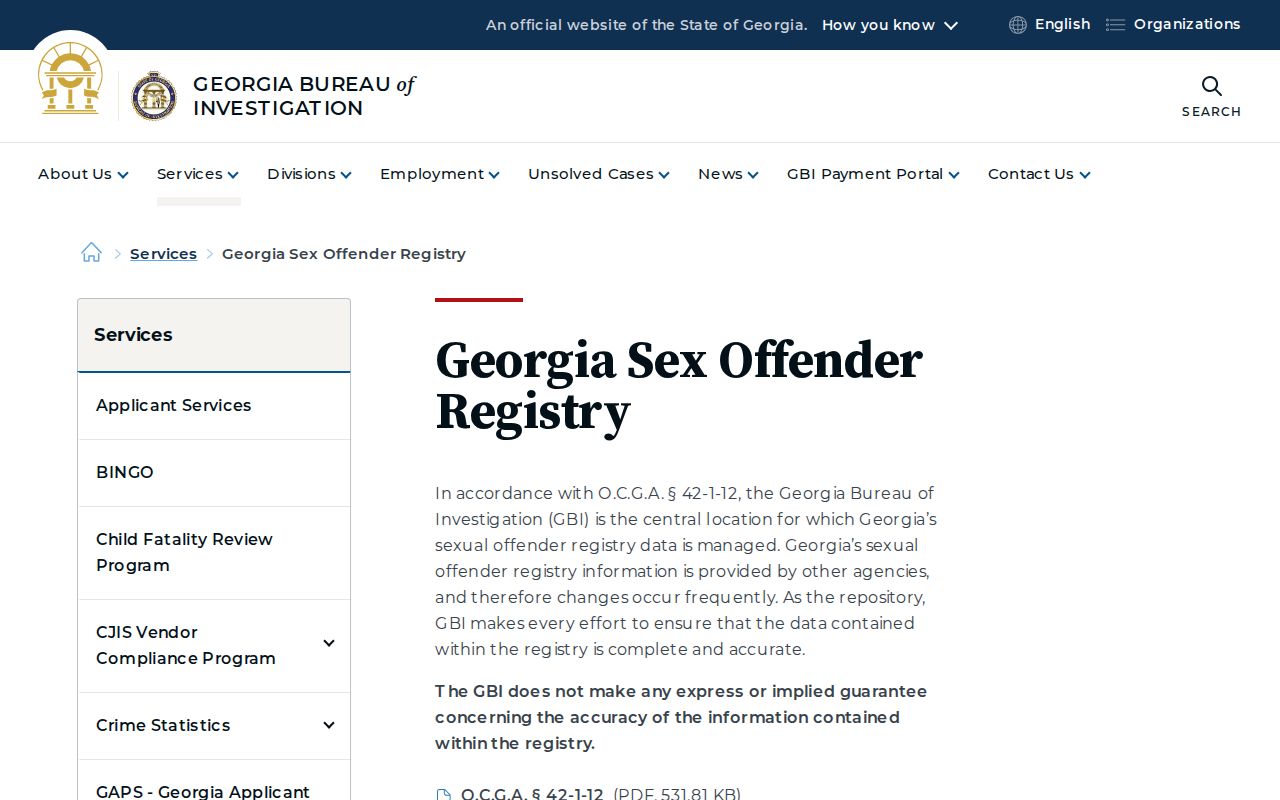
Registry inclusion is statutory and narrow; it does not describe every person at an address, and its information must never be used for harassment.
Rome Court Names Must Go to the Correct Clerk
Floyd Superior, State, Magistrate, Probate, and Juvenile courts and Rome Municipal Court maintain different files. The Georgia court e-access directory identifies providers, but Floyd is not listed in the inspected provider table, so the relevant local clerk is the dependable route. Search a normalized full name with middle initials and variants, note the person's party role, and verify case number, filing date, and disposition. Sealed matters, juvenile records, and protected attachments remain unavailable.
Probate has a useful statewide index for estates, wills, guardianships, marriages, and petitions from 2006, subject to county and record limits. An heir search can move from a public probate petition to the personal representative and then to an estate deed. A court match alone never proves that two same-name people are the same resident.
The Georgia Courts e-access page illustrates why a Rome search must first identify the participating court and provider.
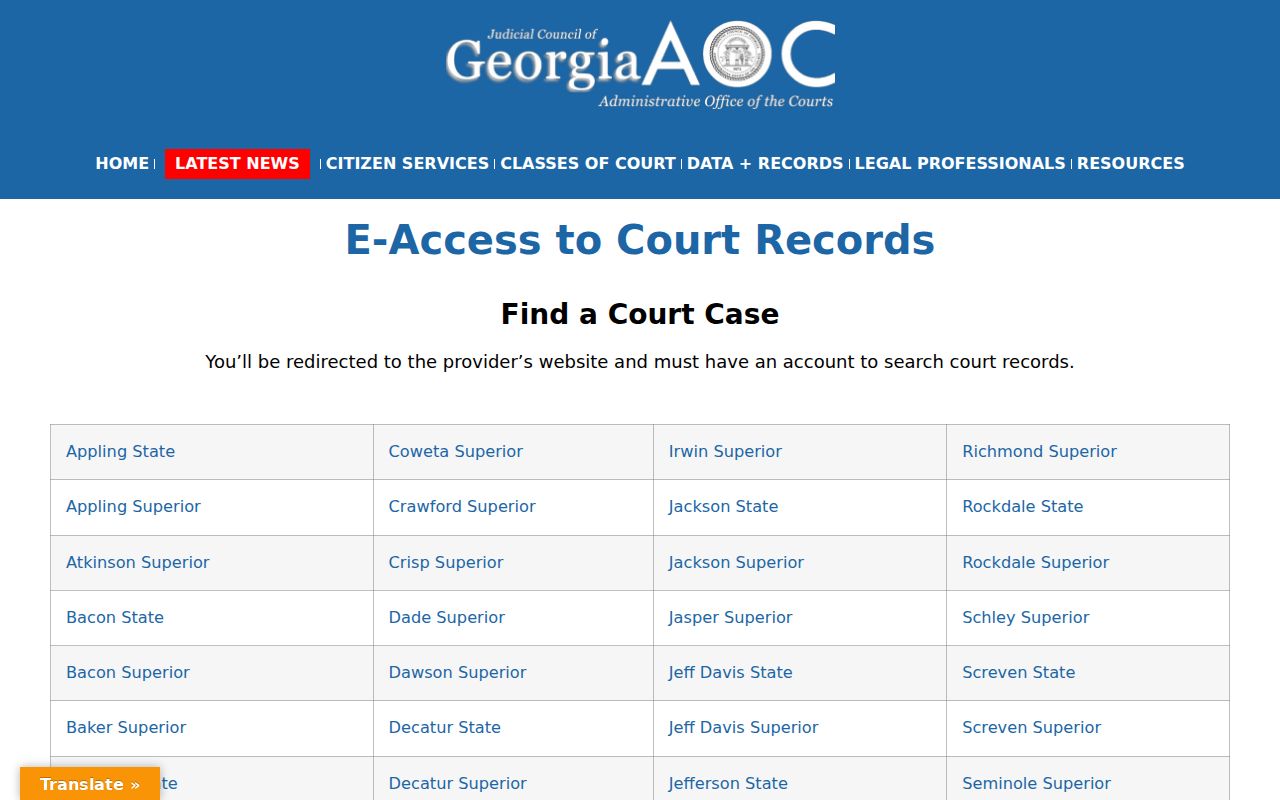
The provider directory is an orientation tool; the Floyd or Rome clerk remains the authority for the local file.
For estates and wills, the Georgia Probate Records search supplies the separate statewide entry point used by Floyd Probate Court.

Its 2006-present Floyd coverage makes it a strong starting index, while older or protected material still belongs with the county clerk.
Marriage, Divorce, Birth, and Death Split by Era
Georgia DPH holds births and deaths from January 1919, marriage certificates from 1952 through 1996, and divorce verifications from June 1952 through August 1996. Floyd Probate Court supplies marriages issued locally before 1952 and after 1996. The Floyd Superior Court Clerk holds actual divorce decrees granted there. A DPH divorce verification is not the signed decree.
Certified births and deaths are not general-public inspection records under O.C.G.A. §31-10-25. Applicants must qualify and supply identification. Available channels include DPH mail, online ordering, a county vital-record office, and walk-in service. Stated timing ranges from generally same-day walk-in service to two to four weeks online and eight to ten weeks by mail. Use historical indexes, cemetery sources, newspapers, and probate for lawful genealogy where a restricted certificate is unavailable.
The Georgia DPH request page shown below distinguishes record types and ordering routes.
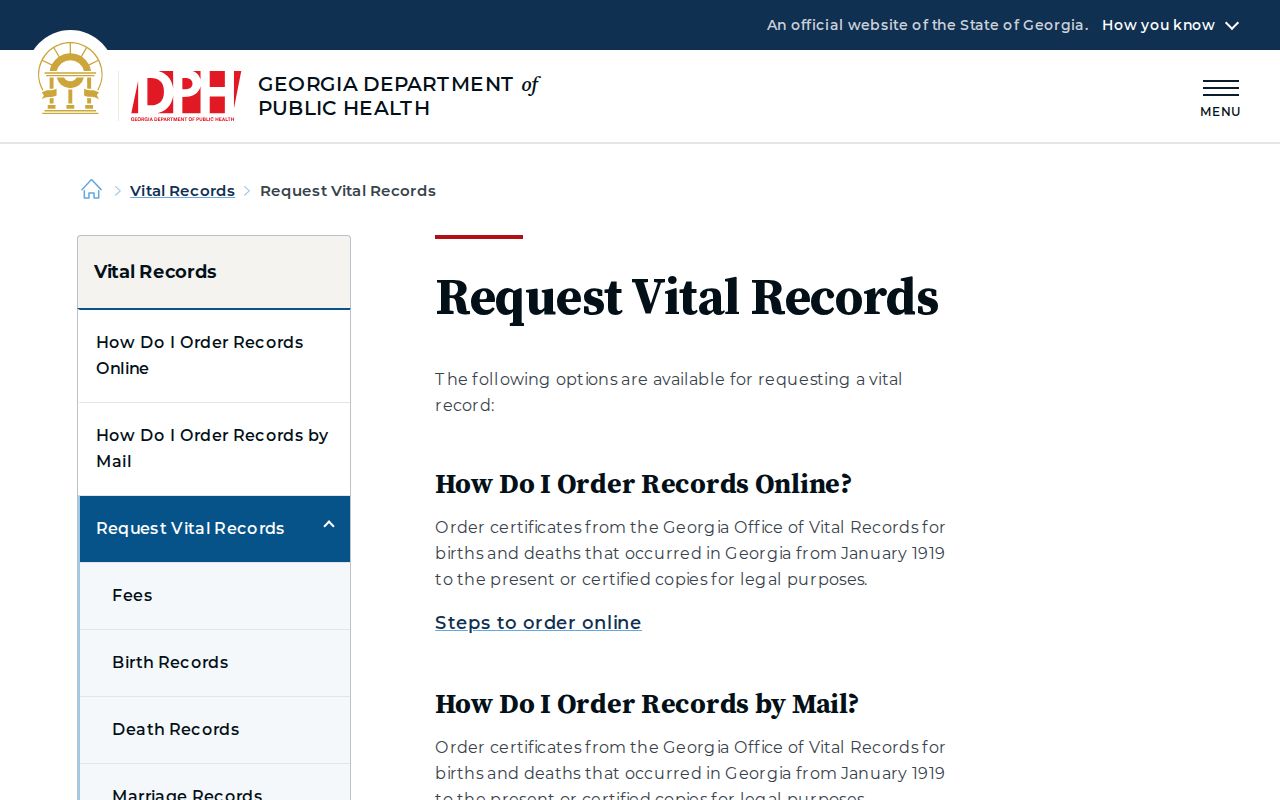
Choose the custodian by event year before paying, because the state office, Probate Court, and Superior Court do not supply interchangeable documents.
Rome Business and License Names Add Affiliation
The Georgia Corporations Division business search accepts a business name, control number, registered agent, or officer and can reveal entity roles and business addresses. The Secretary of State's professional verification search supports name and license fields, including wildcard techniques. Medical, nursing, real-estate, legal, and other board indexes add status and professional contact details where published. Rome's City Clerk keeps business- and alcohol-license records; no comprehensive public city license database was confirmed, so request an existing register or record directly.
These sources are locally useful because Rome is a regional center for health care, education, manufacturing, retail, and services. They establish a recorded business or credential relationship, not a private residence. Pair an entity address with a parcel, filing history, or other dated source before drawing a conclusion about a person.
When a Rome Portal Ends, Request the Existing Record
The Georgia Open Records Act, O.C.G.A. §50-18-70 et seq., provides a practical fallback for city, county, and state records not posted online. Send the request to the actual custodian, identify the record type, date span, address or case number, and ask for electronic delivery and a cost estimate. Agencies generally must respond within three business days; inspection, copying, search, retrieval, and necessary redaction can carry reasonable charges under §50-18-71.
Ask for an existing index, file, or export rather than demanding that staff create a new report. Rome's archive can keyword-search minutes and departmental PDFs, while the city Form Center routes several local requests. For older deeds, court books, directories, and election material, the better fallback chain is the courthouse counter, Rome-Floyd Library Heritage Room, and Georgia Archives microfilm.
The official Georgia open-records request example illustrates the identifying fields and fee explanation.
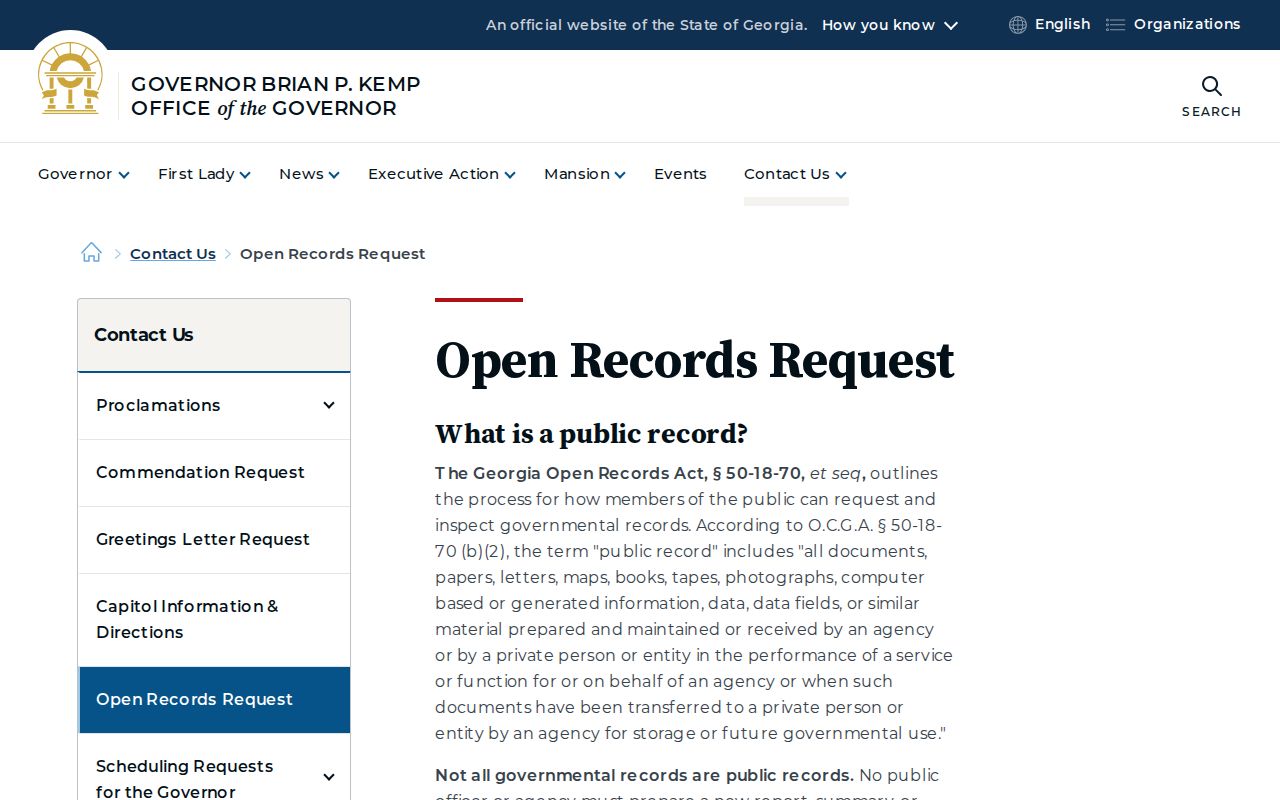
A precise request helps the custodian find the existing Rome or Floyd County record while preserving exemptions for protected information.
Historical Rome Residents Across Shelves and Scans
Documented Rome city-directory editions run noncontinuously from 1913 through 1960. Digitized white and yellow pages cover about 1936 through April 1947 and April 1948 through March 1961, while the regional Georgia Room catalog lists Rome telephone books for 2010-2013. Polk's Rome directory also reaches named communities and subdivisions beyond a narrow city core, so an entry does not prove that the address was inside incorporated Rome.
An entry may include surname, initials, spouse, occupation or employer, and home address; later telephone books usually list subscriber, address, and number. Reverse sections, when present, turn an address into a possible occupant. Compare the edition before and after a target year, then pair it with the 1950 census, deeds, Floyd historical newspapers, cemetery records, or the 1915 Sanborn atlas. The Rome city directory guide covers the fragmented digital runs and the Heritage Room at 205 Riverside Parkway NE.
Rome's Record Geography Crosses Rivers and Limits
A “Rome, GA” mailing address can sit outside city limits while still falling under Floyd County taxation and recording. The Etowah and Oostanaula rivers, which form the Coosa, divide street geography; numbered avenues and NE, NW, SE, and SW directionals make exact address forms important. Mount Berry has institutional postal geography, and Lindale, Shannon, Garden Lakes, Horseleg, and other named areas appear differently in directories, maps, and municipal records.
USPS ZIP assignment, incorporated boundary, voting precinct, historic district, and tax parcel are separate layers. Annexation may change which city department holds a permit or service record without changing the mailing ZIP. Use the latest Rome-Floyd GIS for current jurisdiction and historic maps for earlier context. Never infer identity, relationship, or residency from a neighborhood name alone.
What Rome Records Deliberately Leave Private
Public access has defined boundaries. Georgia vital certificates require statutory eligibility; adoption, juvenile, and sealed court files are restricted; the federal Driver's Privacy Protection Act closes motor-vehicle address data; and VoteSafe can remove a qualifying voter's residence address from disclosure. Utility accounts, school enrollment, private association membership, and the identity of renters or minors are not general public directories. An unsuccessful search may reflect a lawful protection or simply that the chosen roll never covered the person.
Use public information only for lawful personal research such as genealogy, estate work, reconnecting with relatives or classmates, checking a seller's recorded interest, or understanding local history. Do not attempt to defeat a protected-address program, access an account, impersonate someone, or use a directory to watch, threaten, or harass a person. When a record appears wrong, contact the custodian that created it: Assessors for parcel information, the Clerk for deed or court indexing, election officials for registration, DPH for vital amendments, or the responsible licensing board for credential data.
A correction belongs at the source. A copied directory entry or search result cannot amend a government record. Preserve the record date and citation, explain the specific error to the custodian, and ask what evidence its correction process requires.
A Rome Record Timeline From Deed Books to E-Filing
Floyd County was created in 1832, setting the beginning of county deed, court, and tax custody; earlier land history runs through Cherokee and Georgia land-lottery material. Georgia Archives has digitized indexed Floyd Deed Book F for 1848-1850, including warnings about faded ink. Rome's 1915 Sanborn atlas contains 36 sheets, while city and telephone directories bridge much of the twentieth century. The 1950 census divides Rome through wards, Militia District 919, river boundaries, and avenues, a useful clue when a street or surname is poorly indexed.
Probate's public portal begins in 2006. Recent Rome-Floyd map updates include precinct, transit, and zoning layers, and the Clerk moved self-filers into mandatory electronic real-estate filing in 2025. These milestones improve access but do not create one continuous online resident roll. A sound Rome residents directory search still moves between web portals, office counters, physical shelves, microfilm, and digitized archives.